Put Call Ratio (PCR) Explained: How to Use PCR for NIFTY Trading Decisions
The put call ratio NIFTY is one of the most watched sentiment indicators on the NSE options chain — yet most retail traders either misread it or use it in isolation, leading to poorly timed entries. The ratio is deceptively simple: divide the total put open interest (or volume) by total call open interest (or volume). But the real edge comes from understanding when the PCR signals a genuine reversal, when it's just noise, and how institutional positioning distorts the number.
If you've ever seen NIFTY PCR spike to 1.5 and wondered whether to buy calls or wait, or watched it drop to 0.7 and panicked about a crash, this guide will give you a concrete framework. Not theory — actionable rules you can apply to tomorrow's expiry.
What the Put Call Ratio Actually Measures
The PCR is a sentiment gauge. It measures the ratio of bearish bets (puts) to bullish bets (calls) in the options market. On NSE, you can calculate it two ways:
- Volume PCR = Total Put Volume ÷ Total Call Volume (for the day)
- Open Interest PCR = Total Put OI ÷ Total Call OI (cumulative)
For NIFTY trading decisions, OI-based PCR is far more reliable than volume PCR. Volume PCR fluctuates wildly intraday — a single large block trade in the first 15 minutes can distort it. OI-based PCR reflects actual positions that traders are holding overnight, which makes it a better read of committed sentiment.
Here's the baseline you need to memorize:
- PCR > 1.0: More puts than calls are open. This is generally bullish — it means more traders are hedging the downside or selling puts (expecting support). The market tends to be contrarian.
- PCR < 0.7: More calls than puts. This is generally bearish — excessive call buying signals retail optimism that often gets punished.
- PCR between 0.85–1.1: Neutral zone. No clear directional signal.
The contrarian logic works because options markets are dominated by sellers (institutional desks, prop firms), and put sellers typically have stronger conviction and deeper pockets than retail call buyers.
How to Use PCR for Trading NIFTY Options — The Practical Framework
Understanding how to use PCR for trading NIFTY options requires more than just reading a single number. Here's a step-by-step framework that works on weekly and monthly expiries:
Step 1: Check the NIFTY Weekly PCR at 9:30 AM
Pull up the NIFTY options chain on NSE's website or any broker terminal. Look at the total put OI and total call OI for the current week's expiry. Calculate the ratio. If you're checking on a Tuesday for Thursday's weekly expiry, this number reflects positions with only 2 days to go — these are high-conviction bets.
Step 2: Identify the Extremes
The PCR oscillates in a range. For NIFTY, historical data shows:
- PCR above 1.3–1.5: Market is near a short-term bottom. Heavy put writing suggests institutions expect support. This is your signal to look for long (call-buying) opportunities.
- PCR below 0.65–0.7: Market is near a short-term top. Excessive call buying by retail, often near resistance. This is your signal to consider bearish trades or at least avoid fresh longs.
For example, on the trading sessions leading into the March 2023 expiry, NIFTY PCR dropped to 0.62 as retail traders aggressively bought 17,800–18,000 CE strikes. NIFTY subsequently fell over 300 points in the next three sessions. Conversely, in June 2023, PCR touched 1.45 near the 18,200 level, and NIFTY rallied 500+ points over the following week.
Step 3: Never Trade PCR Alone
This is the mistake that bleeds accounts. PCR is a confirming indicator, not a standalone signal. Combine it with:
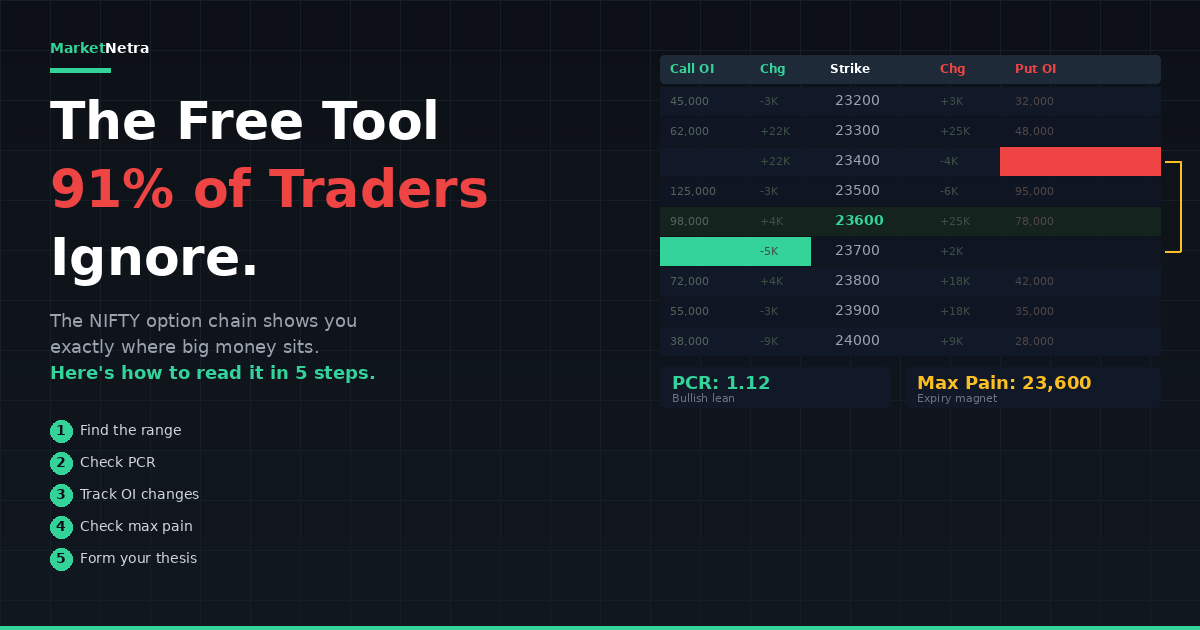
- Max Pain level: If PCR is bullish (above 1.2) AND the current NIFTY spot is below the max pain strike, you have confluence for an upward move.
- Change in OI at specific strikes: A PCR of 1.3 means nothing if the put OI is concentrated at strikes 500 points below spot. Check where the OI is building.
- India VIX: If VIX is above 18 and PCR is at extremes, the signal is stronger because volatility is elevated and mean reversion is more likely.
Dissecting the NIFTY Options Chain: Where PCR Gets Interesting
The aggregate PCR number hides crucial details. Two scenarios can produce the same PCR of 1.2, but the trading implication is completely different:
Scenario A: Heavy put OI at 24,000 PE and 23,800 PE while NIFTY is trading at 24,200. This means institutions are selling puts near the money, acting as a support wall. Bullish.
Scenario B: Heavy put OI is concentrated at 23,000 PE and 22,800 PE — far out of the money — because retail traders are buying cheap puts as lottery tickets. The PCR reads 1.2, but the positioning is weak. No actionable signal.
This is why you need to look at strike-level OI, not just the aggregate ratio. The top 3 strikes by put OI and call OI on the NIFTY weekly chain tell you the expected range institutions are pricing in. If NIFTY is at 24,200 and the highest put OI is at 24,000 while the highest call OI is at 24,500, the market is pricing a 24,000–24,500 range for the week.
Put Call Ratio NIFTY vs. BANKNIFTY: Key Differences
Many traders apply the same PCR thresholds to both indices. This is a mistake.
BANKNIFTY options have structurally different characteristics:
- Higher volatility: BANKNIFTY moves 1.5–2x faster than NIFTY on most days. Its PCR extremes are wider — a PCR of 0.6 on BANKNIFTY is less alarming than 0.6 on NIFTY.
- Skewed participation: BANKNIFTY attracts more speculative retail volume, which inflates call-side volume and suppresses the PCR. The "neutral" zone for BANKNIFTY is closer to 0.75–1.0.
- Expiry dynamics: With weekly expiries on both indices, gamma effects near expiry can cause PCR to spike or drop rapidly on Wednesday and Thursday — these are mechanical moves, not sentiment signals.
If you trade both indices, maintain separate PCR thresholds. For NIFTY, 0.7–1.3 is the normal band. For BANKNIFTY, use 0.65–1.2.
Common PCR Traps That Cost Retail Traders Money
Trap 1: Treating PCR as a timing tool. PCR at 1.4 doesn't mean NIFTY rallies today. It means bullish pressure is building. The actual reversal could take 1–3 sessions. If you buy weekly calls the moment PCR hits an extreme, theta decay can destroy the position before the move materializes. Solution: use PCR for directional bias, but time entries using price action or intraday signals.
Trap 2: Ignoring the trend. In a strong downtrend, PCR can stay above 1.0 for weeks — because put sellers keep getting stopped out and new puts keep getting bought. During the 2022 correction (January–June), NIFTY PCR frequently stayed above 1.1, but the index kept falling. A high PCR in a downtrend means fear is persistent, not that the bottom is in. Always check whether NIFTY is above or below its 20-day EMA before acting on PCR extremes.
Trap 3: Confusing OI buildup with OI unwinding. A rising PCR due to fresh put writing (new OI being added at put strikes) is bullish — sellers expect support. A rising PCR due to call OI unwinding (longs closing their call positions) is neutral to bearish — it signals bulls are exiting. Check the "Change in OI" column, not just absolute OI.
Trap 4: Using PCR on illiquid stocks. PCR works well on NIFTY and BANKNIFTY because of massive OI and deep liquidity. For individual stocks — even liquid ones like RELIANCE or HDFCBANK — the PCR is far less reliable because a single institutional block can dominate the OI structure. Stick to index PCR for sentiment analysis.
Real-World PCR Strategy: Expiry Day Scalping on NIFTY
Here's a specific setup many experienced NIFTY weekly traders use on Thursday expiries:
- At 9:20 AM, check the NIFTY weekly PCR (OI-based).
- If PCR is above 1.2, look for the highest put OI strike. This is the support level for the day. If NIFTY opens above this level, buy calls at or near the ATM strike when NIFTY dips toward the support.
- If PCR is below 0.75, identify the highest call OI strike. This is resistance. If NIFTY opens below this level, buy puts at or near ATM when NIFTY rallies into the resistance.
- Stop loss: If NIFTY breaches the support/resistance strike by more than 30 points on a 5-minute candle close, exit immediately. On expiry day, premium decay is brutal — wrong trades die fast.
- Target: 50–70% of the premium paid. Don't hold for a home run on expiry day.
This setup works because expiry-day price action gravitates toward max pain and high-OI strikes — and the PCR tells you which side has more structural support.
Important caveat: SEBI's 2023 study on F&O trading showed that 89% of individual traders in the equity F&O segment incurred losses. PCR is a probabilistic edge, not a guarantee. Position sizing and strict stop losses are non-negotiable.
What to Actually Do Starting Tomorrow
- Bookmark the NSE option chain page for NIFTY. Check OI-based PCR at 9:30 AM and 1:30 PM daily. Log the numbers for 2 weeks to build your own sense of the range.
- Track PCR alongside India VIX. When both give the same directional signal (e.g., PCR > 1.3 + VIX dropping from a spike), the setup has higher reliability.
- Use the 0.7–1.3 band as your decision zone. Inside the band, PCR tells you nothing actionable. Outside it, start building a directional bias — but confirm with strike-level OI and price action.
- For weekly expiries, give PCR signals only 1–2 days of runway. For monthly expiry cycles, PCR extremes can signal moves that play out over 5–7 sessions.
- Never risk more than 2% of your trading capital on a single PCR-based trade. The signal has a roughly 60–65% hit rate at extremes — that edge only compounds if you survive the losing trades.
The put call ratio NIFTY is a blunt instrument when used carelessly and a sharp edge when combined with OI analysis, VIX context, and disciplined execution. Master the framework above, and you'll read the options chain the way institutional desks do — not as a crystal ball, but as a probability map.
Tracking PCR manually every session is a grind — and the real-time picture changes fast. MarketNetra's AI-driven dashboards synthesize options chain data, PCR shifts, and OI heatmaps into actionable signals so you can focus on execution, not data crunching. Explore the tools at marketnetra.in.