Max Pain in NIFTY Options: What It Is, How to Calculate, and Does It Actually Work?
Max pain in NIFTY options is one of the most discussed — and most misunderstood — concepts among NSE derivatives traders. Every Thursday, as weekly expiry approaches, thousands of retail traders pull up max pain charts hoping to predict where NIFTY will settle. Some swear by it. Others call it a myth dressed in a formula.
Here's the reality: max pain is a useful reference point, not a crystal ball. It tells you where option sellers collectively face the least payout — and since option sellers (institutions, market makers) control most of the open interest, there's a gravitational pull toward that level. But the pull isn't always strong enough to matter, and knowing when it works versus when it doesn't is what separates a practical trader from a hopeful one.
This article breaks down exactly what max pain means, how the nifty max pain calculation expiry day works step by step, when it has predictive value, and — critically — when you should ignore it entirely.
What Max Pain Actually Means in NIFTY Options
Max pain (also called the "maximum pain point" or "option pain") is the strike price at which the total rupee value of all outstanding call and put options expires worthless. At this strike, option buyers collectively lose the most money, and option sellers keep the maximum premium.
The theory behind it is simple: option writers — who in the Indian market are overwhelmingly institutional participants with deep pockets — have the capital and position size to influence prices toward the max pain level as expiry approaches. They do this through delta hedging, aggressive selling near key strikes, and unwinding positions in the underlying (NIFTY futures or the basket of NIFTY stocks).
For NIFTY weekly options (expiring every Thursday), max pain is recalculated constantly as open interest shifts. For monthly options (last Thursday of the month), the dynamics are stronger because total open interest is typically 2-3x higher than a regular weekly expiry.
Key point: Max pain doesn't suggest NIFTY "must" close at that level. It suggests a zone — usually within ±50-75 points of the calculated strike — toward which there's gravitational pull, especially in the final 24-48 hours before expiry.
How to Calculate Max Pain for NIFTY Options
The nifty max pain calculation expiry day is straightforward in concept but tedious by hand. Here's the step-by-step logic:
Step 1: Gather Open Interest Data
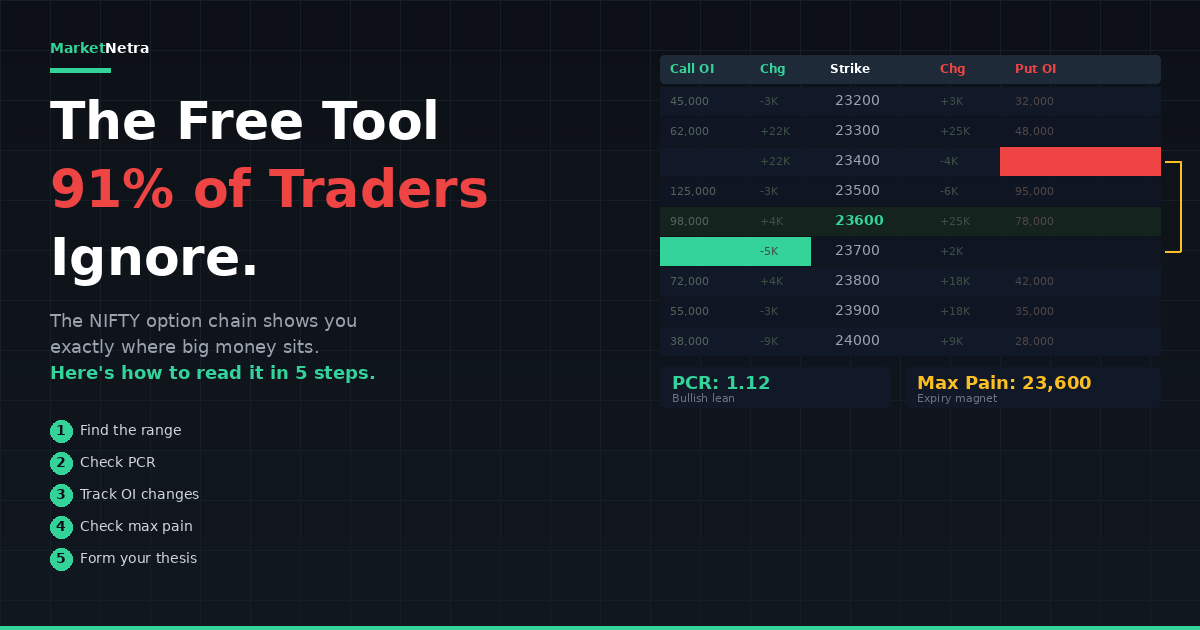
Go to NSE's option chain page for NIFTY. Note the open interest (OI) in number of contracts for every active strike — both calls and puts. For a typical weekly expiry, you'll see OI distributed across strikes from roughly 500 points below to 500 points above the current NIFTY spot level.
Step 2: Calculate Loss at Each Strike
For each possible expiry level (each strike price), calculate:
- Call buyer losses: For every call strike below the assumed expiry level, call buyers make money. For every call strike above it, call buyers lose their entire premium. Add up the intrinsic value payouts for all in-the-money calls.
- Put buyer losses: For every put strike above the assumed expiry level, put buyers make money. For every put strike below it, put buyers lose their entire premium. Add up the intrinsic value payouts for all in-the-money puts.
Multiply each loss by the open interest at that strike and by the lot size (currently 25 for NIFTY).
Step 3: Find the Minimum Total Payout
Add call payout and put payout at each assumed expiry level. The strike where this total is lowest is your max pain.
Example: Suppose NIFTY is trading at 24,350. Open interest is heaviest at:
- 24,500 CE: 1.2 crore shares OI
- 24,000 PE: 1.5 crore shares OI
- 24,300 CE: 85 lakh shares OI
- 24,200 PE: 90 lakh shares OI
If the total payout by option writers is minimized at 24,300, that's your max pain strike.
In practice, you don't need to do this manually. NSE's own option chain data, combined with tools built specifically for Indian markets, can auto-calculate this in real-time as OI changes throughout the day.
Does Max Pain Actually Work? The Evidence
This is where most articles get vague. Let's look at real data.
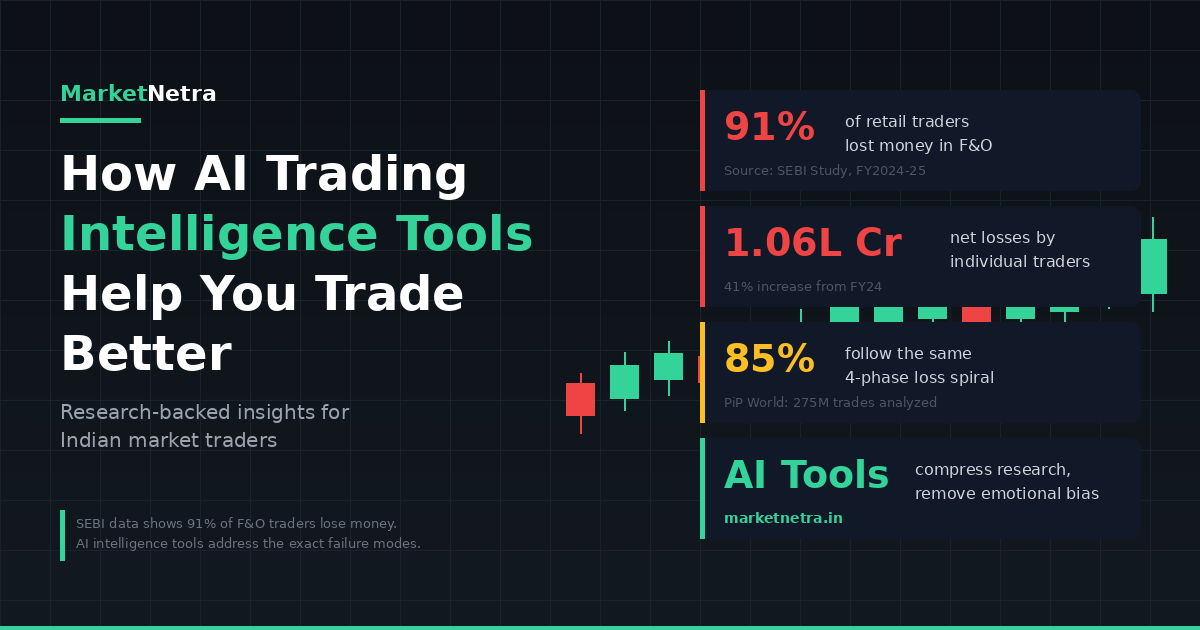
SEBI's 2023 derivatives study found that approximately 89% of individual option buyers lost money. That staggering number is the macro validation of the max pain thesis: the house (option sellers) wins overwhelmingly, and they win by options expiring worthless — which is exactly what max pain measures.
Now for the more granular evidence. If you backtest NIFTY weekly expiries over the last two years (2023-2024), you'll find:
- In roughly 60-65% of weeks, NIFTY's closing price was within ±100 points of the max pain level calculated at 9:30 AM on expiry day.
- In about 40-45% of weeks, the close was within ±50 points.
- In the remaining 35-40% of weeks, NIFTY blew past the max pain zone entirely — often on days with global macro events, RBI policy decisions, or unexpected earnings from heavyweights like RELIANCE or HDFCBANK.
Those numbers tell you something important: max pain works more often than not, but it fails frequently enough that blind reliance on it will blow up your account. A 60% hit rate sounds decent until you realize the 40% misses can involve 200-400 point swings that destroy short straddle or short strangle positions sized on max pain assumptions.
When Max Pain Works Best
- Low-volatility weeks with no major scheduled events (no RBI MPC, no US Fed, no Union Budget adjacent)
- When OI is heavily concentrated at 2-3 strikes with clear peaks, rather than evenly distributed
- In the last 2-3 hours of expiry day, when gamma effects force dealers to hedge aggressively toward the max pain zone
- Monthly expiries, where total open interest is massive enough that the gravitational pull is stronger
When Max Pain Fails Completely
- Event-driven days: RBI rate decisions, global risk-off events, major earnings surprises (TCS, INFY, HDFCBANK results weeks)
- Trending markets: When NIFTY is in a strong one-directional move (like the October 2024 selloff), max pain becomes irrelevant — momentum overwhelms the gravitational pull
- When PCR (Put-Call Ratio) is extreme: A PCR above 1.5 or below 0.7 often signals that the market is directional enough to override max pain dynamics
- Late OI shifts: If massive call writing or put writing happens on Wednesday evening or Thursday morning, the max pain calculated from Tuesday's OI is stale
How Institutional Traders Use Max Pain vs. How Retail Traders Misuse It
Institutional option sellers don't "target" max pain like a GPS destination. What actually happens is subtler:
-
Market makers delta-hedge continuously. As options decay toward expiry, their delta hedging in NIFTY futures naturally pushes the index toward high-OI strikes. This is a mechanical, not conspiratorial, process.
-
Large option sellers roll or adjust positions in ways that often add OI at or near max pain, reinforcing the level.
-
Pin risk — the tendency for the underlying to "pin" near a high-OI strike at expiry — is a well-documented phenomenon in every options market globally, not just NSE.
Retail traders, on the other hand, often misuse max pain in these ways:
- Selling straddles at max pain strike assuming the index will stay there. This works until it doesn't, and the loss on a single miss can erase 5-10 winning trades.
- Ignoring intraday OI changes. Max pain at 9:15 AM is not the same as max pain at 2:30 PM. OI shifts throughout the day, especially on expiry Thursdays.
- Using max pain in isolation without checking India VIX levels, PCR trends, or the futures basis. Max pain is one input, not the entire thesis.
Max Pain for BANKNIFTY and Stock Options
The same calculation applies to BANKNIFTY weekly options and individual stock options (RELIANCE, TCS, INFY, ICICIBANK, etc.), but with important differences:
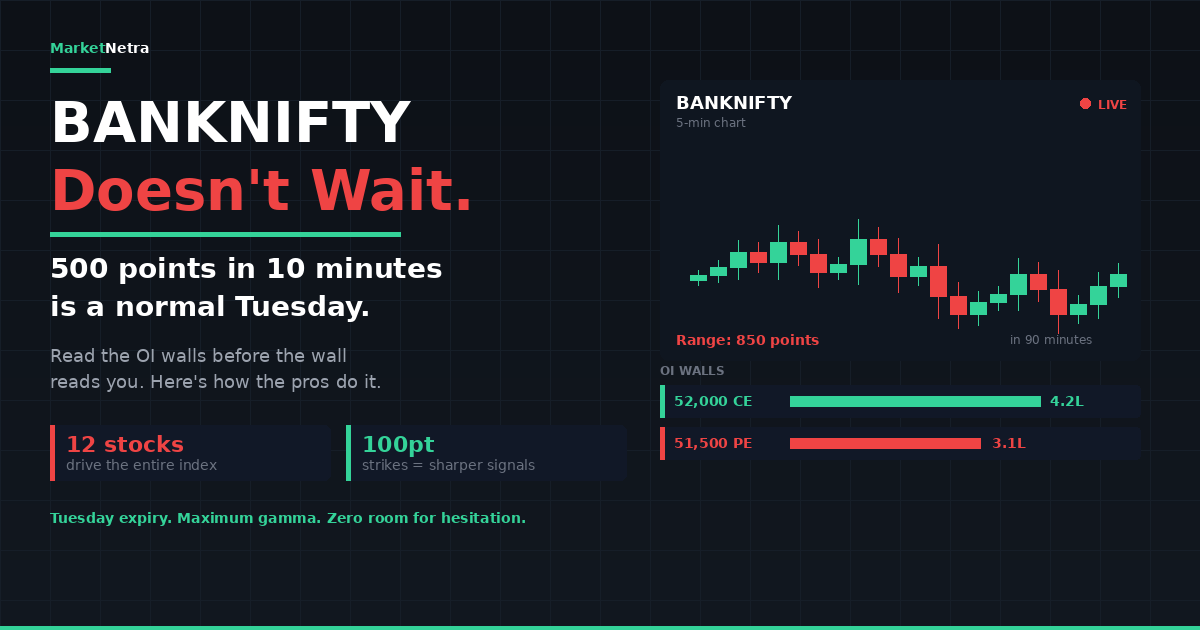
BANKNIFTY (lot size 15) has its weekly expiry on Wednesday. OI tends to be concentrated in wider 500-point intervals compared to NIFTY's 100-point strikes, making the max pain zone broader. BANKNIFTY is also significantly more volatile (typical daily range of 400-600 points vs. NIFTY's 150-250), so the pinning effect is weaker.
Stock options have monthly expiry only (last Thursday). Liquidity is concentrated in 5-10 names. For liquid stocks like RELIANCE (lot size 250), HDFCBANK (lot size 550), or TCS (lot size 175), max pain can be a useful zone-finder for covered call strategies. For less liquid stock options, the OI is too thin for max pain to be meaningful.
What to Actually Do With Max Pain Data
Here's a practical framework for using max pain in NIFTY options without falling into common traps:
-
Check max pain level on Wednesday evening after the market closes. Note the strike and the OI distribution shape. Is it a sharp peak (strong magnet) or a flat plateau (weak signal)?
-
Confirm with PCR. If NIFTY PCR is between 0.8-1.3 and max pain is within 100 points of the spot price, the pinning probability is higher. Outside this range, be cautious.
-
Check India VIX. If VIX is below 14, max pain tends to hold because low volatility means less momentum to push past the zone. If VIX is above 18, max pain is unreliable — the market has enough energy to blow through any OI cluster.
-
Use max pain as a zone, not a target. If max pain is at 24,300, think of 24,200-24,400 as the probable range, not 24,300 as a precise pin.
-
On expiry day, recalculate at 12:00 PM and 2:00 PM. If max pain has shifted 100+ points from the morning reading, the new level is more relevant.
-
Never sell naked options purely based on max pain. If you sell a straddle at the max pain strike, define your risk with a stop loss or hedge with an OTM strangle. The weeks when max pain fails are exactly the weeks that produce outsized moves.
-
Combine with support/resistance. If max pain aligns with a technical support/resistance level, the confluence strengthens the signal. If they contradict, trust the price action over the OI theory.
Max pain is a statistical tendency, not a market law. Treat it like a weather forecast — useful for planning, dangerous if you bet the house on it.
Beyond the Theory: Making Max Pain Actionable
Understanding max pain in NIFTY options gives you one more lens to evaluate expiry-day dynamics, but the traders who consistently profit are the ones who combine OI analysis with volatility data, price action, and real-time adjustments. Static calculations done once on Wednesday night aren't enough — you need live OI tracking, PCR monitoring, and VIX overlays to know whether the max pain signal is strong or stale on any given Thursday.
This is precisely where platforms like MarketNetra add value — by synthesizing live option chain data, max pain calculations, and AI-driven signals into a single, actionable view so you spend less time on spreadsheets and more time on decisions. Explore the tools at marketnetra.in and see how real-time intelligence can sharpen your expiry-day edge.