Best F&O Strategies for Weekly Expiry: A Data-Backed Guide

Finding the best F&O strategy for weekly expiry is the single most common obsession among Indian retail traders — and for good reason. Weekly options on NIFTY and BANKNIFTY now account for over 85% of total NSE derivatives volume, yet SEBI's own 2023 study revealed that 89% of individual F&O traders lost money between FY22 and FY24. The gap between volume and profitability tells you everything: most traders are playing the weekly game without a real edge.
This guide doesn't promise miracle returns. What it does is break down the specific strategies that have a statistical basis for profitability on weekly expiry, show you exactly how to structure them for Indian market mechanics, and explain why capital efficiency matters more than win rate. If you're trading NIFTY or BANKNIFTY weeklies with ₹1-5 lakh capital, every section here is written for you.
The weekly expiry cycle — every Thursday for NIFTY, every Wednesday for BANKNIFTY (post the recent SEBI consolidation reducing weekly expiries to one per exchange) — creates a unique theta decay profile that can be exploited systematically. But only if you understand the math behind it.
Why Weekly Expiry Behaves Differently from Monthly Expiry
Weekly options are not simply "shorter monthly options." Their Greeks behave in fundamentally different ways that most retail traders don't account for.
Theta acceleration is extreme. A NIFTY 24500 CE option with 5 days to expiry might lose ₹3-4 per day in time value. The same strike with 2 days to expiry loses ₹8-12 per day. On expiry day itself, an OTM option 100 points away can lose 60-80% of its remaining value in the last 3 hours of trading. This isn't linear — it's exponential, and it's the single biggest reason why option buyers lose consistently on weeklies.
Gamma risk is concentrated. ATM options on expiry day have extremely high gamma. A 50-point NIFTY move can cause a 300-400% change in an ATM option's value. This means expiry-day trades are inherently binary — they either work spectacularly or blow up. No amount of "conviction" changes the math.
Implied volatility (IV) crush is predictable. NIFTY weekly options typically see IV inflate by 1-3 percentage points on Tuesday-Wednesday and collapse on Thursday. BANKNIFTY shows similar behavior peaking Monday-Tuesday before its Wednesday expiry. This IV pattern is tradeable.
Understanding these three dynamics — theta acceleration, gamma concentration, and IV rhythm — is the foundation for every strategy below.
The Best F&O Strategy for Weekly Expiry: Ranked by Risk-Reward
Let's cut to the strategies that actually work, ranked by their suitability for typical retail capital (₹2-5 lakh).
1. Credit Spreads (Bull Put / Bear Call)
This is the single most reliable weekly expiry strategy for consistent income. Here's why.
You sell an OTM option and buy a further OTM option as protection. Example: On a Monday with NIFTY at 24,500, you sell the 24,200 PE (₹45) and buy the 24,100 PE (₹28). Net credit: ₹17 per share = ₹17 × 50 (lot size) = ₹850 per lot. Maximum risk: (100 - 17) × 50 = ₹4,150 per lot. Margin required: approximately ₹18,000-22,000 after the spread benefit.
Win probability: When you sell strikes 1.5-2 standard deviations OTM with 3-4 days to expiry, historical data on NIFTY shows a 70-78% probability of expiring worthless. That's not a guarantee — it's a statistical edge that compounds over time.
Why it suits small capital: With ₹2 lakh margin, you can comfortably run 4-5 lots of NIFTY credit spreads. If you're looking for a nifty weekly options strategy for small capital, this is the most margin-efficient approach available.
Key rule: Never let max loss exceed 2% of your total capital per trade. Size accordingly.
2. Iron Condor
An iron condor combines a bull put spread and a bear call spread simultaneously. You collect premium on both sides, betting that NIFTY stays within a range.
Example with NIFTY at 24,500 on Monday:
- Sell 24,200 PE, Buy 24,100 PE (₹17 credit)
- Sell 24,800 CE, Buy 24,900 CE (₹15 credit)
- Total credit: ₹32 × 50 = ₹1,600 per lot
- Max risk on either side: ₹3,400 per lot
Iron condors work best when India VIX is between 13-18 — high enough to collect decent premium, low enough that the market is unlikely to make a 300+ point move. When VIX is above 20, the range-bound assumption breaks down and you'll get stopped out frequently.
Data point: Between January 2023 and December 2024, NIFTY's weekly range (high to low) stayed within 350 points roughly 68% of the time. Setting your short strikes 300+ points away on each side captures the majority of these range-bound weeks.
3. Ratio Spreads (for Directional Bias)
When you have a mild directional view — say, slightly bullish on BANKNIFTY before a Wednesday expiry — a ratio spread offers a unique payoff.
Example: BANKNIFTY at 52,000 on Monday.
- Buy 1 lot 52,200 CE at ₹280
- Sell 2 lots 52,800 CE at ₹95 each
Net debit: ₹280 - ₹190 = ₹90 × 30 (BANKNIFTY lot size) = ₹2,700.
If BANKNIFTY closes at 52,800 on Wednesday, your long CE is worth ₹600 while both short CEs expire worthless. Profit: (₹600 - ₹280) × 30 = ₹9,600 minus the short premium already collected. Maximum profit occurs right at the short strike.
Warning: Above 52,800, you're net short one lot. The strategy has unlimited risk on the upside if BANKNIFTY explodes past 53,400+. Always set a stop loss at the breakeven point on the risk side, or convert to a butterfly by buying a further OTM call as a hedge.
4. Calendar Spreads (Sell Weekly, Buy Monthly)
This exploits the differential theta decay between weekly and monthly options. Sell the current week's ATM option and buy the same strike in the monthly expiry. The weekly option decays faster, generating net profit if the underlying stays near the strike.
This strategy works particularly well during the first two weeks of a monthly expiry cycle when the monthly option still has significant time value. Its margin requirement on NSE is relatively low because the long monthly option offsets the short weekly.
Expiry Day-Specific Tactics That Actually Work
Expiry day trading is a different beast entirely. Here's what the data says works:
Selling strangles at 9:30 AM on expiry day. With NIFTY at 24,500 on Thursday morning, selling the 24,300 PE and 24,700 CE — both 200 points OTM — typically collects ₹15-25 combined with just 6 hours of time value left. These options need to decay to zero, and they do roughly 65% of the time. But when NIFTY trends 250+ points intraday (happens about 12-15 times per year), the loss can be 5-10× the premium collected. You must use strict stop losses — exit if the combined premium doubles.
Buying ATM straddles before a known event. RBI policy day, Union Budget day, or US Fed announcement day straddles on NIFTY can return 40-80% if the move exceeds the premium paid. The key is buying 1-2 days before the event when IV hasn't fully inflated. On the actual event day, IV is usually already priced in.
The 3:00 PM scalp. In the last 30 minutes of expiry, options at ₹1-5 can make 10-20× moves on a 30-50 point NIFTY swing. This is pure gambling unless you have a systematic approach with pre-defined position size. Allocate no more than ₹2,000-3,000 to such trades — treat it as lottery money, not strategy money.
Risk Management: The Part Most Traders Skip
No discussion of the best F&O strategy for weekly expiry is complete without risk rules. Here are the non-negotiable ones:
Position sizing comes first. If your total trading capital is ₹3 lakh, your maximum loss on any single weekly trade should be ₹6,000-9,000 (2-3%). This means you can't sell naked options — period. Even one gap-up or gap-down can wipe out months of small gains.
Correlation kills. Running a bull put spread on NIFTY and BANKNIFTY simultaneously isn't diversification — it's concentration. Both indices are 60-70% correlated. If you're selling puts on both, a broad market selloff hits both positions. Diversify by strategy type (one credit spread, one iron condor) rather than by underlying.
The 2× stop loss rule. If you collected ₹20 in premium on a credit spread, set a stop loss to exit if the spread widens to ₹40 (2× premium collected). This mechanically limits your loss to roughly 1:1 risk-reward on losing trades while letting winners expire worthless for full profit. Over 100+ trades, this asymmetry generates positive expectancy.
Track your actual numbers. After 30-40 weekly trades, calculate your win rate, average winner, average loser, and expectancy. If your win rate is 70% with average win ₹800 and average loss ₹3,500, your expectancy is: (0.70 × 800) - (0.30 × 3,500) = 560 - 1,050 = -₹490 per trade. You're losing money despite a 70% win rate. This is exactly how most credit spread sellers blow up — they win small, lose big, and never run the numbers.
Capital Allocation: Making Weeklies Work with ₹1-5 Lakh
A practical nifty weekly options strategy for small capital needs to account for margin realities post-SEBI's peak margin rules.
With ₹1 lakh: You can run 1-2 NIFTY credit spreads (100-point wide). Expected weekly income: ₹700-1,200 on winning weeks. Target 8-10 winning weeks out of every 13 (one quarter). This gives you ₹5,600-12,000 per quarter, or roughly 6-12% quarterly return before losses. After accounting for losing weeks (3-5 per quarter at ₹2,000-4,000 loss each), net return drops to 2-5% per quarter. That's 8-20% annually — which beats most mutual funds, but it's not the 5% weekly nonsense you see on Instagram.
With ₹3 lakh: Now you can diversify. Run 2 NIFTY credit spreads + 1 BANKNIFTY iron condor simultaneously. Weekly premium collection: ₹2,500-4,000. Account for 30-35% losing weeks and your net annual return range is 15-30%.
With ₹5 lakh: Add a BANKNIFTY directional trade (long debit spread) on weeks where you have a technical setup. This asymmetric bet — risking ₹3,000-5,000 to make ₹15,000-25,000 — boosts overall returns when it hits, while the credit spreads provide base income.
Critical: These return projections assume discipline, consistent execution, and no revenge trading. The moment you double your position size after a loss, the math breaks.
Tools and Timing: When to Enter Weekly Trades
Monday/Tuesday entry for credit spreads. You want 3-4 days of theta decay. Entering on Wednesday for a Thursday NIFTY expiry leaves too little premium and too much gamma risk.
Strike selection using standard deviation. Calculate 1.5 SD move for the week: take NIFTY's ATM straddle price and multiply by 0.6. If the ATM straddle is trading at 350 on Monday, expected weekly move is ~210 points. Sell your short strikes beyond this range (1.5-2×).
Avoid event weeks. RBI policy (6 times a year), quarterly results of heavyweights (RELIANCE, TCS, HDFCBANK, INFY), and US FOMC meetings create outsized moves that blow through typical credit spread ranges. Either skip these weeks or widen your strikes significantly.
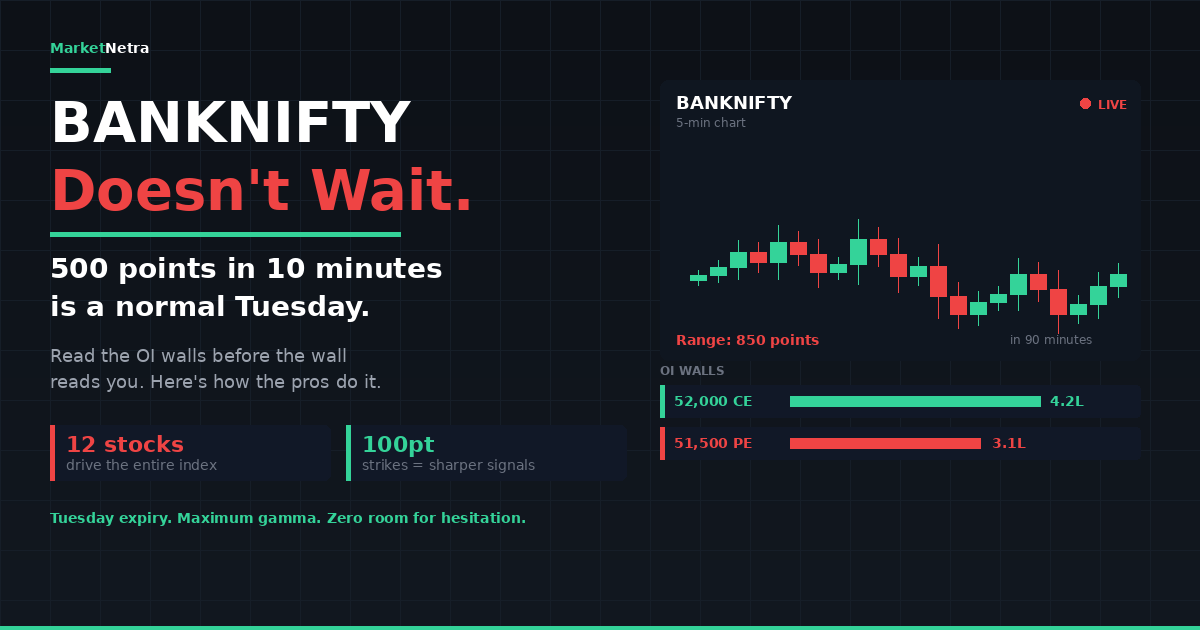
Use OI data for strike selection. The strike with maximum put OI typically acts as weekly support; max call OI acts as resistance. NSE publishes this data at 15-minute intervals. If NIFTY 24,000 PE has 1.5 crore OI and 25,000 CE has 1.2 crore OI, your iron condor range is roughly defined.
VIX filter. If India VIX is below 11, premiums are too thin for credit spreads — your risk-reward is terrible. If VIX is above 22, ranges are too wide for iron condors — directional strategies (debit spreads, straddles) work better. The sweet spot is VIX 13-18.
What to Actually Do This Week
Here's a concrete action plan:
-
Check India VIX on Monday morning. If it's 13-18, proceed with credit spreads or iron condors. If it's above 18, consider debit spreads or wait.
-
Calculate the expected weekly range using the ATM straddle price. Sell strikes outside 1.5× this range.
-
Enter NIFTY credit spreads (or iron condors) by Tuesday afternoon. Use 100-point wide spreads for small capital, 200-point for larger accounts.
-
Set a 2× premium stop loss immediately after entry. Do not monitor the position obsessively — check at 3:15 PM daily.
-
On expiry morning (Thursday for NIFTY), if your short strike is still 100+ points away and premium has decayed 70%+, let it expire. If the market has moved against you but hasn't hit your stop, close for a partial loss rather than hoping for a reversal.
-
Log every trade in a spreadsheet: date, strategy, strikes, premium collected, outcome, P&L. After 30 trades, review your actual edge.
-
Never allocate more than 50% of your capital to any single expiry. Keep dry powder for adjustments or the next week.
The best F&O strategy for weekly expiry isn't a single magical setup — it's a framework of high-probability trades, strict risk limits, and relentless tracking. The traders who survive in this game are the ones who treat weekly options as a business with known costs (losing weeks) and expected revenue (winning weeks), not as a slot machine.
Platforms like MarketNetra are built precisely for this kind of systematic approach — using AI-driven analysis of OI data, IV patterns, and historical probability to help you identify which weekly setups actually have an edge, so your decisions are grounded in data rather than gut feel.