AI vs Your Gut: Why Data-Driven Trading Beats Intuition — SEBI Data Proves It (2026)
You know the feeling. NIFTY drops 200 points in 30 minutes. Your BANKNIFTY puts are printing money. Your gut says hold — this is the big one, the crash you've been waiting for. Twenty minutes later, a sharp V-shaped recovery wipes out your unrealised profits and pushes you into a loss. You hold anyway, because your gut still says down.
By 3:30 PM, your puts expire worthless. Your gut was wrong. But it felt so right.
This is the story of nearly every retail F&O trader in India. Not occasionally — systematically. SEBI's data proves it with numbers that should make every intuition-driven trader uncomfortable.
The Numbers That Should End the Debate
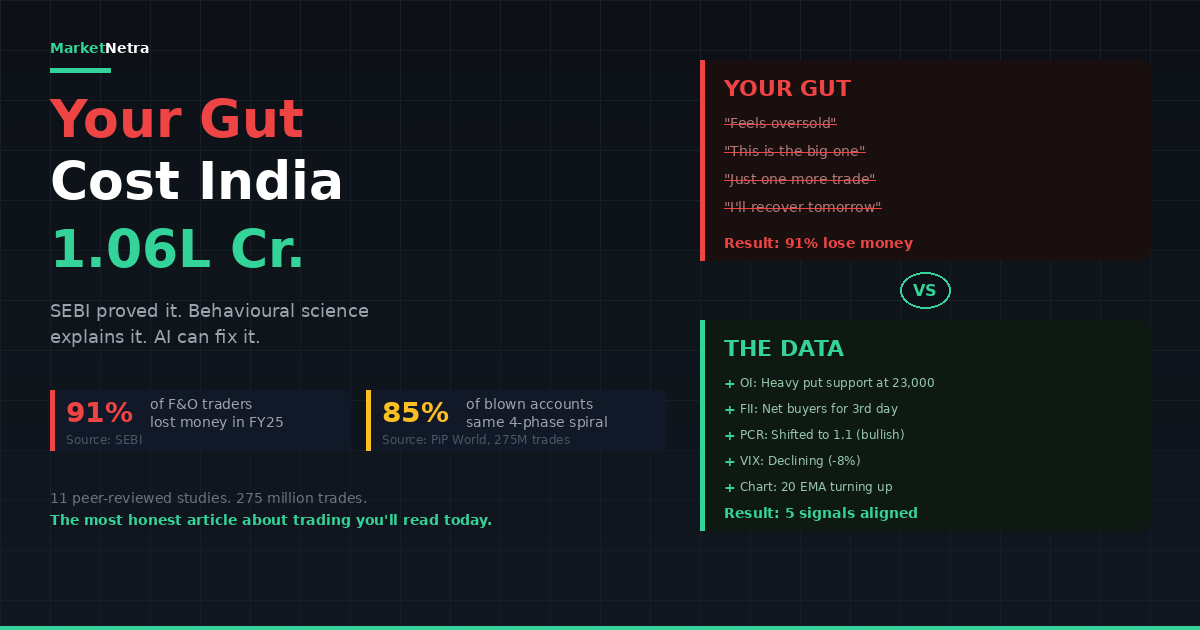
SEBI's July 2025 study found that 91% of individual traders in the equity F&O segment lost money in FY2024-25. Not a bad year — the same pattern held the previous year too. An earlier SEBI study covering FY22 to FY24 showed 93% of individual traders incurred losses, with aggregate losses exceeding ₹1.8 lakh crore over just three years.
In FY24-25 alone, net losses hit ₹1,05,603 crore — a 41% increase from the previous year. The average loss per person was ₹1.1 lakh. Nearly 96 lakh unique traders participated. Nine out of ten walked away poorer.
Now here's the part that separates this from a generic "trading is risky" warning. The CFA Institute's November 2025 analysis revealed that 97% of FPI profits and 96% of proprietary trader profits came from algorithmic trading systems. Institutions aren't trading on gut feel. They're trading on data processed at speeds and scales that human intuition cannot match.
The losing 91% had access to the same market data. The same option chain. The same charts. What they had instead of algorithms was intuition — and intuition lost.
Why Your Gut Lies to You (The Science)
This isn't a character flaw. It's biology.
The Overconfidence Tax
The landmark study by Barber and Odean at UC Berkeley examined 65,000 individual brokerage accounts. The finding: the most active traders earned significantly lower returns than less active traders and the market averages, after accounting for costs. Overconfidence didn't lead to better outcomes. It led to more trades, more costs, and worse returns.
India-specific data is striking: day-trading activity in India rose by 400% between FY2019 and FY2023, with the number of individuals doing intraday trades rocketing from about 1.5 million to 6.9 million. Most were young, from smaller cities, and losing money. About 70% of day traders incurred losses — climbing to 76% for traders under 30 and 80% for those executing 500+ trades per year.
More trades. More confidence. Worse results.
A 2025 study found that overconfident traders trade approximately 45% more frequently than they should, eroding annual returns by 1–3% through excessive transaction costs alone. That's before counting the directional losses from bad entries and exits.
Loss Aversion: The Silent Account Killer
Your brain processes losses approximately twice as painfully as it processes equivalent gains. This isn't metaphor — it's well-documented neuroscience that Kahneman and Tversky established in the 1970s.
A meta-analysis examining 31 empirical studies found loss aversion to be the single strongest emotional bias affecting investment decisions, with a correlation of r = 0.492. Regret aversion followed at r = 0.401 and overconfidence at r = 0.346.
In practice, loss aversion manifests as:
- Holding losing positions far too long (hoping for a recovery that statistically rarely comes)
- Cutting winners too early (locking in gains before they disappear)
The combination is devastating: you ride your losers down and cut your winners short. Over hundreds of trades, this asymmetry bleeds accounts dry.
A study of retail investors in Bengaluru found that loss aversion was the strongest predictor of irrational investment decisions, with approximately 46.8% of the variance in trading decisions explained by behavioural biases alone — meaning nearly half of what drives decisions has nothing to do with market analysis.
The Four-Phase Death Spiral
PiP World's study of 275 million trades across 8 million accounts found something chilling: 85% of failed trading accounts followed the identical four-phase behavioural spiral.
Phase 1: Cautious Success. You start carefully. Small positions, reasonable stops. You make modest profits. The market seems manageable.
Phase 2: Overconfidence Formation. A few winners build confidence. You increase position size. You start trusting your read more than the data. Your gut says you've figured it out.
Phase 3: Catastrophic Loss. A series of losses hits. Instead of cutting, you double down. Stop-losses widen. Revenge trading sets in — not as a conscious choice, but as an emotional compulsion.
Phase 4: Terminal Decline. Trading becomes compulsive. The goal shifts from profit to recovery. By the end, account liquidation feels like relief.
The study found this pattern repeated with clockwork precision across geographies, asset classes, and experience levels. This is what gut-driven trading produces at scale. Not occasionally — systematically.
What Data-Driven Trading Actually Means
Let's be precise, because the term gets thrown around loosely.
Data-driven trading doesn't mean following a mechanical system blindly. It means making decisions where data is the primary input and emotion is the controlled variable — not the other way around.
Here's the difference in practice:
Gut-driven entry: NIFTY is falling. It feels oversold. Your friend in the trading group says "support at 23,000." You buy a call option because the fear feels overdone.
Data-driven entry: NIFTY is at 23,050. The option chain shows heavy put OI at 23,000 (genuine support). FIIs were net buyers yesterday for the first time in five sessions. PCR has shifted from 0.75 to 1.1 (sentiment shifting bullish). India VIX is declining. The 20 EMA on the hourly chart is turning up. You buy a call option because five independent data signals align.
Both trades might work. Both might fail. But over 200 trades, the second approach produces better risk-adjusted outcomes because it's based on repeatable, multi-signal confluence rather than a feeling that changes with your P&L, your sleep quality, and whether you had a good breakfast.
Why AI Is the Bridge Between Data and Decision
The challenge with data-driven trading isn't the concept — every trader agrees it's better in theory. The challenge is execution.
Reading the option chain takes 5–10 minutes. Checking FII/DII data takes 2 minutes. Analysing the chart takes 5 minutes. Cross-referencing all of these takes another 5 minutes. That's 20 minutes of work before a single trade — and you need to redo it every time the picture shifts during the day.
Most traders don't have 20 minutes per decision. Especially not when they're in a live position, the market is moving, and their cortisol is elevated. So they shortcut — they check one indicator, glance at the chart, and go with their gut on the rest.
AI intelligence tools solve this specific problem. They compress the 20-minute multi-source analysis into a 10-second query. "Is this trade supported by the data right now?" The AI pulls from the option chain, FII flows, technicals, and volatility simultaneously and gives you the confluence picture — or tells you the data doesn't support your thesis.
This isn't AI predicting the market. This is AI preventing you from making decisions on incomplete information under emotional pressure. Which is exactly how most of the ₹1.06 lakh crore in retail losses happens.
As PiP World's analysis concluded, traders don't need to become emotionless to succeed. They only need to stop managing the part of the process where emotion does the most damage — the execution stage. AI doesn't replace your judgment. It replaces the gap where your gut hijacks your judgment.
The Practical Protocol: Gut Check vs Data Check
Every time you feel the urge to enter or exit a trade, pause for 10 seconds and ask yourself one question: "Am I making this decision based on data I've checked, or based on how I feel right now?"
If the answer is feeling — run a quick data check. Ask your AI tool: "Quick status on [your position] — OI, flows, and momentum." The answer takes 10 seconds.
- If the data supports your gut — proceed with confidence
- If the data contradicts your gut — reduce your position size by half
This isn't about ignoring intuition entirely. Experienced traders do develop genuine pattern recognition over time. But even experienced intuition needs to be validated against data — because overconfidence doesn't spare veterans. Barber and Odean found that the most active traders, presumably the most experienced, had the worst returns.
Why This Matters More for Indian Markets
Indian F&O markets have characteristics that amplify the gut-vs-data problem.
Weekly options expiries create a compressed decision cycle where emotional pressure peaks every week. SEBI data shows that the highest losses concentrate around expiry days — precisely when emotional trading is most intense.
The concentration in short-dated index options means gut-driven trades are essentially binary bets with rapid time decay. When your BANKNIFTY 52,000 CE expires in 48 hours, there's no time for your gut to be wrong and recover. The data either supports the trade or it doesn't.
FII activity complexity adds another layer intuition alone cannot process. On any given day, FIIs might sell ₹3,000 crore in the cash market while simultaneously adding long futures positions. Without the data to decode this, your gut sees "FIIs selling → bearish" when the reality might be rotation, not exit.
The Bottom Line
On one side: human intuition. The same cognitive system that produces loss aversion, overconfidence, revenge trading, FOMO, anchoring, and the disposition effect. A system that produced a 91% loss rate across 96 lakh traders and ₹1.06 lakh crore in aggregate losses in a single year.
On the other side: data. Option chain positioning, institutional flows, volatility context, technical confluence. Synthesised in 10 seconds. Unemotional. Consistent whether you're up ₹50,000 or down ₹50,000 on the day.
Your gut has been trading Indian markets for years. How's it doing?
The data doesn't lie. The data doesn't panic. The data doesn't revenge-trade after a loss or get overconfident after a win. The data just shows you what's actually happening, fast enough for you to act on it, without the emotional filter that has cost Indian retail traders over ₹1.8 lakh crore in three years.
That's not a theoretical argument. That's SEBI's data proving it.
Sources & Citations
- SEBI Study (July 2025) — 91% of individual F&O traders lost money in FY24-25; net losses of ₹1,05,603 crore, up 41%.
- SEBI Study (September 2024) — 93% of individual traders lost money FY22–FY24; aggregate losses exceeded ₹1.8 lakh crore.
- CFA Institute Market Integrity Insights (November 2025) — 97% of FPI profits from algorithmic trading.
- Barber & Odean, UC Berkeley (2000) — Most active traders earned lowest returns; 65,000 accounts analysed.
- PMC: Overconfidence Bias in the Indian Stock Market (2022) — Overconfidence robust across all market conditions in India.
- Preprints.org (2025) — Overconfident traders trade ~45% more frequently; 1–3% annual return erosion.
- Emerald Publishing, IIMT Journal of Management (2024) — Meta-analysis of 31 studies: loss aversion r = 0.492, overconfidence r = 0.346.
- RSIS International (2025) — Loss aversion β = 0.312 as strongest predictor; 46.8% variance from behavioural biases.
- PiP World / Hedge Fund Alpha (November 2025) — 275M trades, 8M accounts; 85% of failed accounts follow identical four-phase spiral.
- Moneylife (December 2025) — ₹1.06L crore individual F&O losses confirmed in Parliament.
For educational purposes only. Not SEBI-registered investment advice.